%20(1).svg)
Overview
I may have built the most accurate shopping algorithm on earth.
But it only works for me.
I scribbled this idea on a notepad a few years ago after paying too much for something I didn't want or need. I was bingeing Black Mirror at the time. Having spent the last two months going all in on AI fluency, I've revisited a stack of old blue-sky ideas and I'm now building them as fast as I can. Not to sell. Just to enjoy creating things again.
This one is about privacy, data, advertising, and identity.
Here's the context:
- Trillions of dollars are spent understanding and then selling our data every year
- Companies that excel at personalisation drive 40% more revenue
- The future of advertising is being framed as "personalised, pervasive, and proactive"
- Current systems are powerful. But it's still guesswork. And it certainly doesn't serve us as consumers, or as human beings
- People hate surveillance advertisement
- People love hyper-relevant recommendations
So I built something different. It’s kind of strange in theory, but potentially a very big, privacy-first idea.
It’s called Identity.Shop.
My contribution
Ideation Creative Direction Build
The team
Dom
Year
2026

Process
Long story short, I’ve created my own algorithm using my own data, to ‘advertise’ only to myself.
Think - explicit, consented identity data > inferred behavioural data + only one target. It’s completely unique. A self-optimising, user-owned commerce brain.
Monetisation flips too. Instead of brands paying ad companies to guess what you want, they pay to fulfil what you’ve already decided.
I gave this algorithm an abundance of first-party data, but also straight-up identity level context. Claude conversations, search history, photos of things I own, location data, sleep data, a spider's web of APIs. Everything.
I figured that with enough real data it might get close to what Meta, Amazon and TikTok can manage, but it wasn’t close.
It was much better.
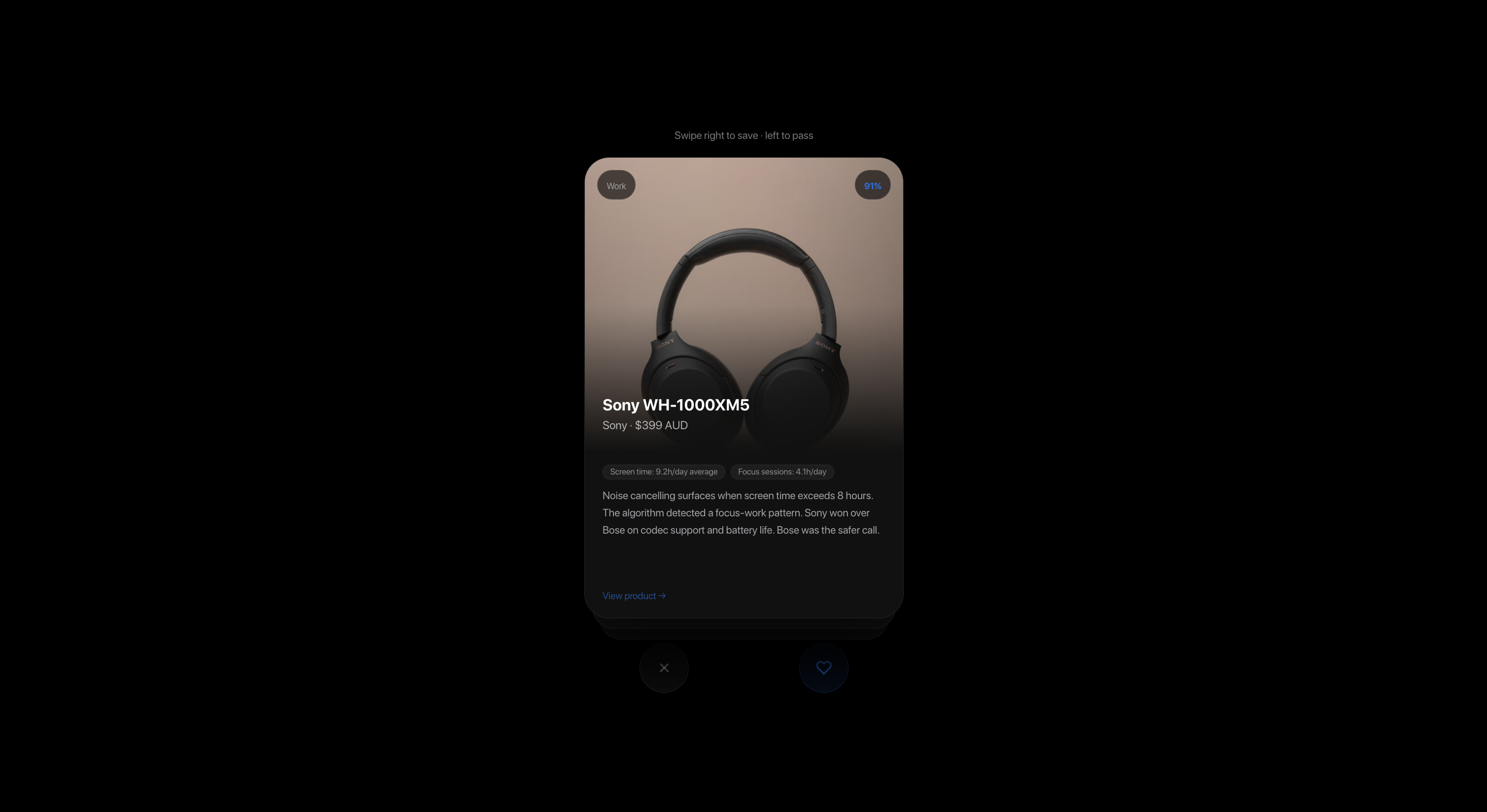
The first product it surfaced: a Billabong Absolute 3/2 Chest Zip Wetsuit. And it told me why based on what it knows.
“Strava surf sessions tagged at Coolangatta shows a winter frequency increase. The algorithm surfaced wetsuit upgrades. It recommended Rip Curl E-Bomb. Billabong fits your build better.”
It knew I surf more in winter. It knew I hadn't bought a wetsuit in years. It knew my dimensions and made a practical call, not a marketing pitch. The reality? My current wetsuit is slightly too tight, worn through at the shoulders with a hole in the back. It was unequivocally right.
The second: LG UltraWide 34" Monitor
“Screen time data + window management patterns. Algorithm detected heavy split-screen usage. Ultrawide eliminates the friction.”
Tracking the way in which I’m using my screen. Solving a real problem. Unreal.
From here, the more I live my life, the better it gets. And I can feed it voluntary feedback at any level of detail whenever I want.
Outcomes
Explicit, consented, self-reported identity data might be more powerful than anything a surveillance algorithm can infer. Also, much more ethical. Imagine if a significant number of consumers decided to use something like this overnight, and continued charting a path that suits us. We’d have more control, transparency and ironically limit risk. It’s entirely possible that overtime we’d see more uniqueness, free ourselves of manufactured desire and bridge that gap between who we are and what we’re sold.
Anyway, I threw a very rough beta website together so you can play around and get the idea. My goal is for this to be an early version of something very real. Would love feedback as I build.
iDentity is not an Apple product 😉
I'll soon have a mobile app you can download and build your own.